
Trusted Human Context Emerges as a Critical Input for AI Systems
mEinstein explores Human Intelligence Infrastructure, giving AI trusted, permission-based access to personal context
Press Release Disclaimer: This is a press release distributed through the XPR Media network. It has not been independently verified by our newsroom.
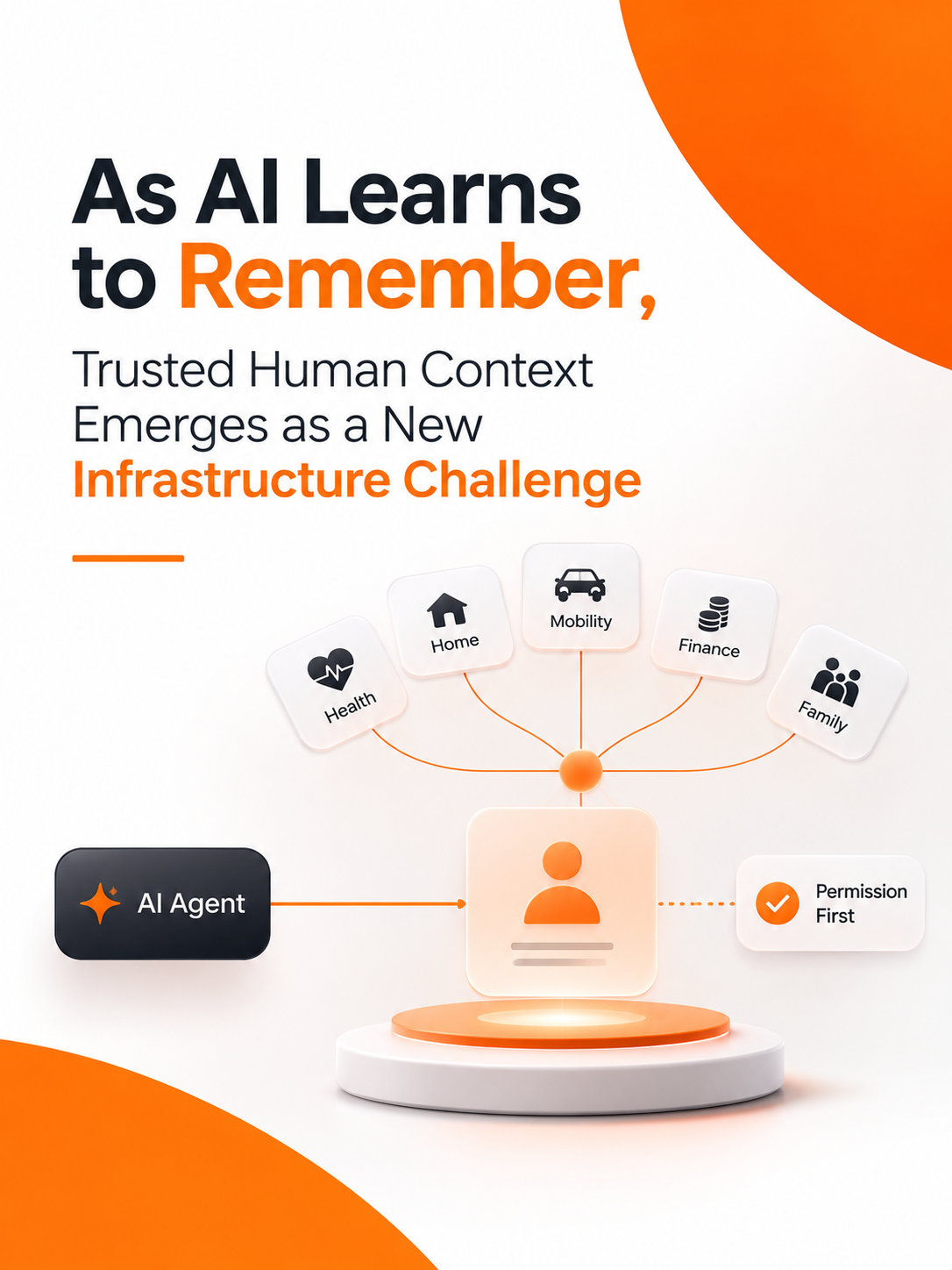

mEinstein explores Human Intelligence Infrastructure, giving AI trusted, permission-based access to personal context through user-controlled intelligence.
BOSTON, MA, UNITED STATES, November 17, 2026 /EINPresswire.com/ — As AI Learns to Remember, Trusted Human Context Emerges as a New Infrastructure Challenge
As artificial intelligence moves beyond chat toward persistent memory, autonomous agents and real-world enterprise workflows, a new infrastructure constraint is emerging: trusted human context.
For much of the current AI cycle, the industry’s biggest constraints have been compute, data-center capacity, energy, advanced chips and access to increasingly capable models. Those constraints remain important. But as AI systems become more intelligent and more widely deployed, another problem is becoming increasingly visible.
AI can know an extraordinary amount about the world while still knowing remarkably little about the human being at the other end of a workflow.
What is happening in that person’s life? What has changed? What are they trying to accomplish? What constraints matter? Are they actually ready to act? And what have they authorized an AI system or enterprise to know or do?
“The first AI infrastructure race was about creating machine intelligence at scale,” said Prithwi Thakuria, Founder & CEO of mEinstein. “The next may increasingly be about giving that intelligence trusted access to human context.”
Recent developments across the AI industry reinforce the importance of the issue. OpenAI, Anthropic and Microsoft are all investing in forms of persistent memory and long-horizon context designed to help AI systems retain useful information across sessions and over longer periods.
That evolution is necessary. An AI assistant that begins every interaction from zero cannot become deeply personal.
But persistent memory also changes the nature of the technology.
An AI that remembers a user’s preferences, goals, constraints, projects and history is doing more than retrieving old conversations. Over time, those memories begin to form patterns. Patterns create context. Context may reveal intent.
“Memory eventually becomes a model of the person,” Thakuria said. “And that raises a much bigger question: who controls that model?”
mEinstein describes a private, continuously evolving representation of an individual’s real-world context as an Algorithmic Self-Portrait. Rather than relying only on prompts or isolated interactions, such a model may include authorized context from areas such as routine, health, finance, mobility, home, family and declared intent.
The company argues that the important distinction is not simply how much AI can remember, but where that intelligence is governed and how it may be used.
“If persistent Personal AI simply produces a richer centralized profile of the individual, we have not necessarily created a new architecture,” Thakuria said. “We may simply have created better surveillance.”
That concern becomes more significant as AI shifts from answering questions toward taking actions.
An AI agent helping with a mortgage application, for example, may understand lending requirements and help organize documents. But deciding that a user appears financially ready is different from having permission to share selected financial information with a lender.
Similarly, an AI system supporting a clinical-trial workflow may be able to evaluate whether a person appears potentially eligible. The enterprise may not need the individual’s entire health history. It may need a verified result, selected evidence and permission to contact the person.
This distinction points toward a different model for enterprise AI.
Instead of transferring unrestricted personal data into enterprise systems, future workflows may increasingly request a specific answer, qualification, context packet or authorized action for a defined purpose.
mEinstein calls the broader architecture Human Intelligence Infrastructure: a permissioned layer connecting Enterprise AI to private human context.
Its model begins with a user-controlled Algorithmic Self-Portrait, followed by a permission boundary defining who may request information, what may be used, why it is needed, how long access lasts and whether authorization can be revoked. Enterprise systems then receive only the approved context or action required for the workflow.
The company is testing elements of this thesis through enterprise work spanning transportation, healthcare, clinical research and financial services, including a paid Phase 1 engagement involving TxDOT and Jacobs.
mEinstein does not characterize those early workflows as proof that a new category has already been established. Instead, the company says the thesis must ultimately be demonstrated through consumer utility, trusted permission behavior, measurable enterprise outcomes and repeatability across multiple workflows.
The larger industry question extends well beyond mEinstein.
As AI gains persistent memory and agents gain the ability to act, understanding the human being behind the task becomes increasingly consequential.
A model can provide intelligence.
Context determines whether that intelligence fits the moment.
Permission determines whether it should be used.
“Compute makes AI powerful,” Thakuria said. “Trusted human context makes it relevant. Permission makes it legitimate.”
Prithwi Thakuria
mEinstein
+1 703-517-3442
Legal Disclaimer:
EIN Presswire provides this news content “as is” without warranty of any kind. We do not accept any responsibility or liability
for the accuracy, content, images, videos, licenses, completeness, legality, or reliability of the information contained in this
article. If you have any complaints or copyright issues related to this article, kindly contact the author above.

Media gallery
